Streamlining Operations: Why an Integrated Platform Is Key
When a business begins to scale, operational complexity expands quietly. In the early days, solving a new operational challenge is simple: pick a specialized software tool, sign up for a subscription, and put it to work. One app manages customer support, another handles team scheduling, a third tracks analytics, and yet another controls event ticketing or infrastructure monitoring.
Over time, this incremental approach creates a hidden tax on growth: software sprawl.
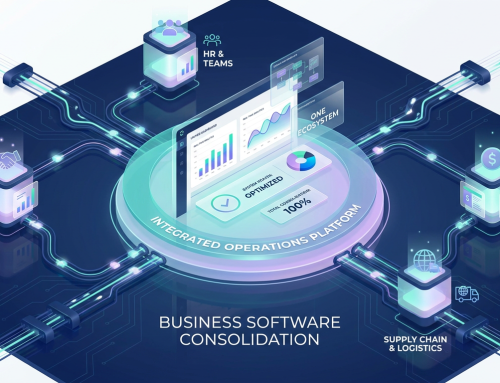
What began as a flexible set of point solutions transforms into a fragmented labyrinth of disconnected systems, isolated data silos, and mounting administrative overhead. Instead of driving speed, the tech stack itself becomes the primary bottleneck to execution. Reclaiming operational momentum requires a fundamental shift in strategy: moving away from scattered point applications and adopting a unified integrated operations platform.
The Hidden Cost of Software Fragmentation in Scaling Companies
Software sprawl is rarely the result of a deliberate strategy; it is the natural byproduct of rapid growth. Departments adopt specialized software independently to solve immediate pain points. However, as these individual applications accumulate, the cumulative cost of managing them explodes across three distinct dimensions: direct financial waste, administrative overhead, and security exposure.
Pro Tip: Conduct a quarterly audit comparing active paid seats against weekly active usage. Uncovering abandoned or redundant licenses is typically the single fastest path to reclaiming 20% to 30% of your software budget.
1. Direct Financial Waste and Subscription Sprawl
Industry benchmarks consistently highlight the massive financial inefficiency inherent in unmanaged SaaS portfolios. According to Zylo’s SaaS management benchmark report, the average growing business now maintains between 275 and 305 SaaS applications. Crucially, the same benchmark reveals that 53% of provisioned SaaS licenses sit completely idle or underutilized.
Furthermore, research published in Spendflo’s IT overspend study estimates that organizations waste 25% to 34% of their total software budget on overlapping application capabilities, unused seat entitlements, and forgotten automatic renewals. For growing mid-market companies, this software fragmentation translates directly to tens or hundreds of thousands of dollars in annual capital waste.
2. Administrative and Maintenance Overhead
Managing dozens of independent software vendors introduces severe operational friction. Every standalone application requires:
- Individual contract renewals, billing management, and expense approvals.
- Separate user provisioning, role permissioning, and offboarding workflows.
- Custom API integrations, webhooks, or manual CSV exports to sync data across tools.
- Specialized team training and onboarding for every distinct software interface.
When point tools fail to communicate natively, internal IT and operations teams spend an inordinate amount of time building and maintaining fragile custom integrations rather than focusing on core strategic initiatives.
The Cognitive Drag: How Tool Fatigue and Context Switching Kill Productivity
While direct subscription expenses are easy to identify on a balance sheet, the human cost of software fragmentation is far more damaging to a company’s bottom line. Forcing employees to navigate a web of disconnected applications creates severe cognitive friction, commonly referred to as tool fatigue.
The Context-Switching Penalty
Knowledge workers spend a significant portion of their workday simply moving between disparate tools. According to landmark Harvard Business Review research on context switching, the average employee toggles between applications approximately 1,200 times per day. This perpetual app-switching consumes nearly 9% of total annual work hours—accounting for 44 to 100+ hours of lost productivity per employee every year.
Beyond the immediate seconds lost during a tab switch, the cognitive cost is cumulative. Studies from UC Irvine demonstrate that every context switch or interruption carries an average 23-minute recovery penalty before an individual regains deep, focused concentration. When team members must jump between five different systems just to complete a single customer request or internal report, deep focus becomes virtually impossible.
Operational Dimension | Fragmented Point Solutions | Integrated Operations Platform |
|---|---|---|
Data Synchronization | Manual CSV exports, fragile Zapier flows, periodic batch syncs | Real-time, native single data model |
User Management | Dozens of logins, complex SSO setups, manual offboarding risks | Centralized access control and single-click provisioning |
Cost Predictability | Unpredictable vendor price hikes, overlapping licensing tiers | Consolidated billing with transparent cost structures |
Employee Onboarding | Steep learning curve across 10+ distinct UI interfaces | Single intuitive interface and unified navigation |
Executive Visibility | Delayed reporting; mismatched metrics across department silos | Live cross-functional dashboards and real-time insights |
The Strategic Advantages of an Integrated Operations Platform
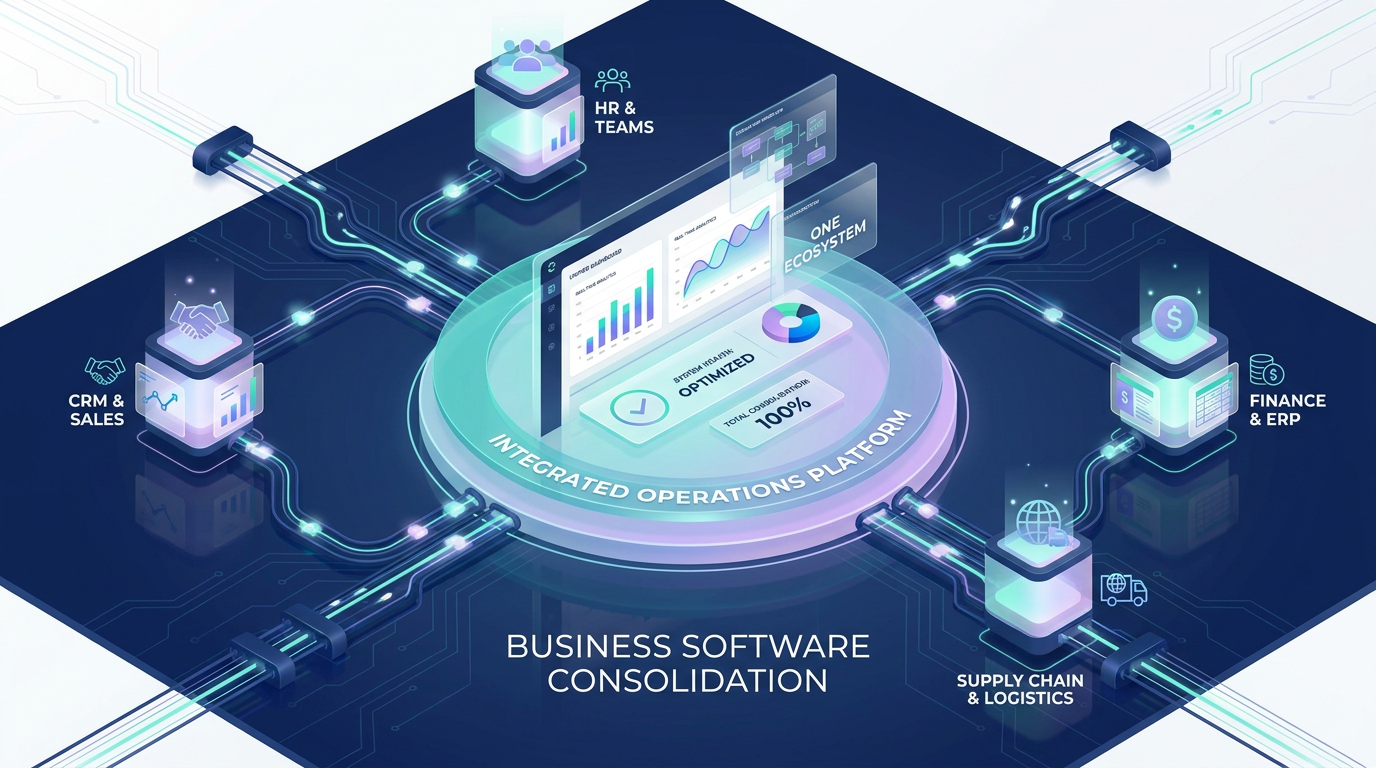
An integrated operations platform replaces fragmented point solutions with a connected suite of tools operating on a shared data architecture and unified user interface. Transitioning to a platform model delivers multi-dimensional operational improvements.
1. Establishing a Single Source of Truth
In a fragmented software ecosystem, different departments rely on conflicting data sources. Sales views customer data in one tool, support tracks issues in another, and operations monitors resource scheduling in a third. This leads to duplicate records, manual data entry errors, and endless debate over which metric is accurate.
An integrated platform eliminates data silos by unifying core operational workflows around a centralized data model. When an operational event occurs—whether a support ticket is logged, a resource is scheduled, or an asset performance metric updates—that information updates instantly across the entire ecosystem.
2. Streamlining Cross-Departmental Workflows
Business processes rarely exist within a single department. A typical operational workflow spans multiple teams and handoffs. With point solutions, moving a task from one stage to the next requires manual notifications, re-keying information, or relying on external automation tools that break whenever an API updates.
Integrated platforms enable seamless end-to-end automation. Triggers in one module automatically initiate actions in another—eliminating manual handoffs, reducing human error, and drastically accelerating execution velocity.
3. Lowering Total Cost of Ownership (TCO)
Consolidating software capabilities into a single platform delivers immediate financial return. As documented in Bird’s operational platform report, businesses that transition from fragmented point tools to unified platforms achieve an average 40% reduction in software expenses while growing 19% faster than competitors burdened by software sprawl.
Key Takeaway: The ROI of tech stack consolidation comes from two sources: direct license savings from eliminating redundant subscriptions, and indirect savings from reduced administrative overhead and accelerated worker productivity.
Point Solutions vs. Integrated Platform: Addressing the Specialization Myth
A common objection to tech stack consolidation is the belief that specialized point solutions always provide superior functionality compared to an all-in-one platform. Historically, legacy enterprise suites suffered from being “jack of all trades, master of none”—offering broad feature coverage with poor user experience.
However, modern platform architecture has transformed this dynamic. Modern integrated platforms are engineered specifically for mid-market and growing operational environments, providing deep, practical capability across core workflows without forcing companies to compromise on usability.
To evaluate whether to keep a specialized point tool or consolidate into a platform, consider this 4-part decision framework:
- Workflow Continuity: Does this workflow cross departmental boundaries? If multiple teams interact with the data, platform integration provides far more value than isolated feature depth.
- Integration Overhead: How much time and capital is spent keeping this point tool synced with the rest of the business? If maintenance costs outweigh feature benefits, consolidate.
- User Adoption: Are employees actually utilizing the advanced features of the point tool, or are they using 20% of its capability? If feature utilization is low, a streamlined platform module will improve overall productivity.
- Data Governance: Does the point tool create compliance, security, or visibility blind spots? Centralizing data within an integrated platform drastically improves security posture.
A Practical 4-Step Framework for Tech Stack Consolidation
Transitioning from a fragmented software stack to an integrated operations platform requires a structured approach. Following a phased implementation framework ensures seamless business continuity without disrupting daily operations.
Phase 1: Software Audit → Phase 2: Workflow Mapping → Phase 3: Rationalization → Phase 4: Phased Migration
Step 1: Conduct a Comprehensive Software & License Audit
Catalog every software tool currently in use across the organization. Document contract renewal dates, monthly per-seat costs, actual active user counts, and owner departments. Identify instances of “shadow IT”—unmanaged tools purchased on team credit cards without central IT oversight.
Step 2: Map Core Workflows and Data Handoffs
Trace the end-to-end lifecycle of core operational processes. Identify where data is manually re-entered, where CSV exports are required, and where team members experience friction when handing work off to adjacent departments.
Step 3: Identify Redundant Tools and Rationalization Candidates
Categorize applications into three groups:
- Core Platform Anchors: Essential systems that form the backbone of operations.
- Consolidation Candidates: Overlapping tools whose functionality can be absorbed by an integrated platform.
- Specialized Exceptions: Unique tools that provide critical, non-negotiable competitive differentiation and justify standalone maintenance.
Step 4: Execute a Phased Migration and Change Management Plan
Avoid attempting a “big bang” cutover where every legacy tool is turned off simultaneously. Instead, migrate operational modules sequentially. Ensure thorough team training and establish clear documentation to build employee confidence in the new, unified environment.
Unlocking Scalable Growth Through Operational Efficiency
For growing businesses, operational efficiency is not merely a cost-cutting initiative; it is a primary driver of competitive advantage. A business weighed down by software sprawl, data silos, and constant context switching will inevitably struggle to match the speed and responsiveness of a streamlined competitor.
By consolidating fragmented point tools into a unified integrated operations platform, leadership teams eliminate invisible software drag, drastically reduce technology overhead, and empower their workforce to focus on high-impact strategic growth.
How BrandNova Connects Core Business Operations
BrandNova brings audience intelligence, event operations, scheduling, monitoring, automation, and visual content workflows into one connected membership. Teams can use PulseCore for polls and audience insights, Event Tickets and QR scanning for admissions, OpenRoster for staff and volunteer scheduling, CronPilot and CronJob for infrastructure monitoring and automation, and Photo Enhancer for polished business imagery.
Rather than forcing growing organizations to manage disconnected subscriptions and separate user experiences, BrandNova provides a unified path to operational visibility, automation, and scale.
Frequently Asked Questions (FAQ)
What is the difference between an integrated operations platform and a point solution?
A point solution is a standalone software application designed to solve one specific task or workflow (e.g., standalone appointment scheduling or isolated issue tracking). An integrated operations platform is a unified software ecosystem that combines multiple operational modules—such as analytics, scheduling, ticket management, and automation—onto a single data architecture and user interface.
How much can a business save by consolidating its tech stack?
Industry studies show that businesses typically reduce their software Total Cost of Ownership (TCO) by 25% to 40% through consolidation. Savings stem from eliminating duplicate software licenses, reducing custom integration maintenance, lowering IT administrative overhead, and reclaiming lost worker productivity.
Will an integrated platform require replacing all of our current software tools?
Not necessarily. Successful consolidation focuses on absorbing redundant or overlapping administrative tools into a central platform while maintaining native API connections to highly specialized, mission-critical systems that provide unique competitive value.